

Born Together

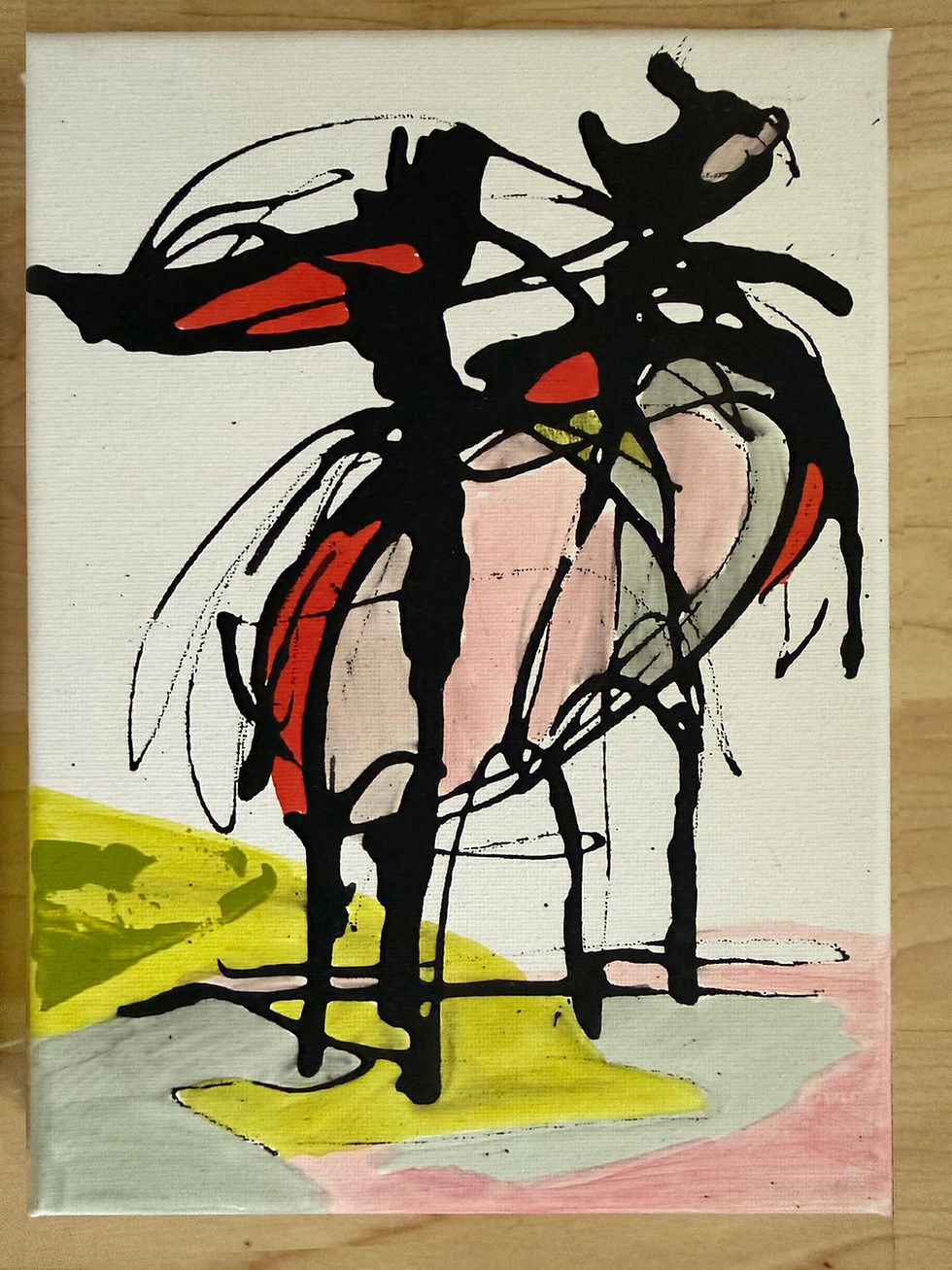
Sometimes two works are born on the same day as a whole, with the same energy. That is what happened with this small A5 diptych.
Both paintings emerged as a quick and very free exercise, almost like a visual notation: a dominant ink line on black, reduced fields of colour, and a very condensed structure. At that small scale, both works are alright. They both have presence, rhythm, and a fairly direct relationship between figure and ground.

But working small is also useful for something else: it helps reveal which image simply works, and which one also contains the potential to grow.
Two works, two different behaviours
The painting on the left interests me because of its compactness. It has a more immediate, frontal, self-contained reading. It works well as a small object, as an intimate work. Its strength lies in that central block-like form, which stands out clearly against the background.

The painting on the right does something different. The line does not simply outline: it moves through the image, organises it, and destabilises it (I love that). The empty space breathes more. The image takes longer to resolve. And precisely because of that, it opens up a question that interests me a great deal:
What happens when a small image does not exhaust itself at its own scale, but begins to ask for translation into another format?
The small format as a laboratory
Not every small work deserves to grow. Sometimes its intensity depends precisely on compression, immediacy, and intimacy of scale.
That is why I like to treat these small studies as a laboratory. Not in order to turn all of them into larger paintings, but to understand which ones contain a structure capable of holding another scale.
In this case, the conclusion became quite clear: both works hold together as a diptych, but the one on the right carries more pictorial potential.
Not because the one on the left has less value, but because the one on the right leaves more space for painting to continue happening.
Decision-making is also part of the process
An important part of my work lies precisely there: comparing, discarding, ranking, and deciding. Not everything that comes out of the studio needs to become a new line of work. Not everything deserves to be scaled up. And not every small image contains a larger work within it.
That kind of decision-making is as much a part of my practice as the act of painting itself.
I am interested in thinking of a work as a field of relationships: colour, form, presence, structure. That dialogue between painting and graphic media has also been present in other series and formats in my practice.
What happens now with these two works
For now, these two paintings remain together as a diptych.
I am interested in keeping them together because they show a very specific moment in the process: two solutions born close to one another, but with different developmental possibilities.
At the same time, the work on the right has opened up a new possibility: a translation into 60 x 40 cm, and perhaps later into a larger scale.
I am not interested in thinking of that future version as an automatic reproduction, but rather as a new work that I will paint based on the same initial structure.

Available work
The original diptych is available as a set.
And the painting on the right remains open as a possible future work in 60 x 40 cm, or even at a larger scale if the image continues to ask for it.
If you would like to receive information about the diptych or about that future translation, you are welcome to get in touch directly


Comments